Tirzepatide Dosing Chart: 2.5-15 mg Weekly Titration, Reconstitution & Side Effects
Weekly tirzepatide titration from 2.5 mg to 15 mg, mg-to-units conversions across 5/10/15/40/60 mg vials, side effects from SURPASS and SURMOUNT, and how it compares to semaglutide.
Tirzepatide Quick Start
Disclaimer
This page is an educational research and dosing reference. It is not medical advice and does not replace guidance from a licensed clinician. Tirzepatide carries a boxed warning for thyroid C-cell tumors. Do not use it without a qualified prescriber if you have a personal or family history of medullary thyroid carcinoma or MEN 2.
Tirzepatide is a once-weekly injection that activates two appetite and blood-sugar hormones at the same time: GIP and GLP-1. The single-target competitor most people know is semaglutide (Ozempic, Wegovy), which only activates GLP-1. Retatrutide goes one step further by adding glucagon receptor activity, but it remains investigational. Tirzepatide activates both GIP and GLP-1, which is why it is called a dual agonist.
It is sold under two brand names. Mounjaro is approved for type 2 diabetes. Zepbound is approved for chronic weight management and for obstructive sleep apnea in adults with obesity. Both are the same drug, the same molecule, and use the same titration ladder. The difference is the indication on the label.
Route
Subcutaneous (under-the-skin) injection, once per week, on the same day each week.
Dose ladder
2.5 → 5 → 7.5 → 10 → 12.5 → 15 mg weekly, with at least 4 weeks between steps.
Measure
Most research vials reconstitute cleanly to 20 mg/mL, where 1 mg = 5 units on a U-100 insulin syringe.
Supplies
Vial, BAC water, U-100 insulin syringes, and alcohol swabs. Reconstituted solution keeps for ~28 days refrigerated.
Research status
FDA-approved drug as Mounjaro/Zepbound. Lyophilized research-use vials are a separate, non-FDA grey-market supply.
Mounjaro vs Zepbound at a glance
Same drug, two indications
Mounjaro Zepbound
Active drug Tirzepatide Tirzepatide
FDA indication Type 2 diabetes Chronic weight management; OSA + obesity
First approved May 2022 November 2023
Form sold by Lilly Single-use pen Single-use pen and vial
Titration ladder 2.5 → 5 → 7.5 → 10 → 12.5 → 15 mg weekly 2.5 → 5 → 7.5 → 10 → 12.5 → 15 mg weekly
The molecule, the dose ladder, and the side-effect profile are identical. The label is the only thing that differs.
Tirzepatide Dosing Protocol & Schedule
Tirzepatide is dosed once weekly. The dose starts low to let the gut adjust, then steps up every 4 weeks. Each step is a 2.5 mg increment. The minimum-effective dose for weight loss or glycemic control is 5 mg. The maximum studied and approved dose is 15 mg. The 2.5 mg, 7.5 mg, and 12.5 mg doses are transitional steps, not long-term targets.
Tirzepatide Dosing Schedule
Choose the format you are researching. The ladder is the same for Mounjaro and Zepbound; the research-vial tab also shows the matching mg-to-units math.
Same titration ladder applied to research-grade lyophilized vials, with insulin-syringe units for each step.
Research-grade tirzepatide is supplied as lyophilized powder in 5/10/15/40/60 mg vials. Once reconstituted with BAC water, you draw weekly doses on a U-100 insulin syringe. The cleanest math is a 40 mg vial reconstituted with 2.0 mL of BAC water, which gives 20 mg/mL.
Mg → Units (40 mg vial + 2.0 mL BAC water = 20 mg/mL)
On a 0.5 mL / 50-unit syringe, 12.5 mg and 15 mg need a larger syringe. Use the calculator below for any other vial-and-water pairing.
Research-use only
Research-grade vials are sold for laboratory research, not for human use. Information here is reported for educational reference; nothing on this page is a recommendation to use research-grade tirzepatide outside of an FDA-approved indication.
Tirzepatide weight-loss dose-tier guide
What each dose did in SURMOUNT-1 (obesity, no diabetes, 72 weeks)
Weekly dose Average weight loss Plain-English read
5 mg −16.0% First real treatment dose. Solid for many.
10 mg −21.4% Mid maintenance. Strong weight effect.
15 mg −22.5% Maximum dose. Diminishing return vs 10 mg.
Source: Jastreboff et al., NEJM 2022 (SURMOUNT-1). Most users do not need to escalate to 15 mg to see meaningful results.
Steady state
Tirzepatide has a 5-day half-life. With weekly dosing, blood levels build up over about 4 weeks before stabilizing at roughly 1.6× a single dose. That is why each phase lasts at least 4 weeks, allowing the body time to adjust before a new dose's effect can be judged.
Tirzepatide Vials (40 mg, reconstituted to 20 mg/mL)
One injection per week. A 40 mg vial covers 28 days of dosing at most maintenance steps.
| Cycle length | Planning note |
|---|---|
| 4 weeks (Phase 1, 2.5 mg) , 8 weeks (through 5 mg) 1 x 40 mg vial | 4 weeks (Phase 1, 2.5 mg): 4 doses × 2.5 mg = 10 mg total. Vial covers it.; 8 weeks (through 5 mg): Roughly 30 mg used over 8 weeks at the 2.5 → 5 mg ramp. |
| 12 weeks (through 7.5 mg) 2 x 40 mg vials | Plan a second vial when stepping past 5 mg. |
| 16 weeks (through 10 mg) 3 x 40 mg vials | 10 mg weekly draws four doses per vial. |
| 24 weeks (full ladder to 15 mg) 6 x 40 mg vials | Add buffer for any held-dose weeks during GI flares. |
Insulin Syringes (U-100)
One syringe per weekly injection. Use 0.5 mL syringes for ≤50 unit draws and 1 mL syringes for higher doses.
| Cycle length | Planning note |
|---|---|
| 4 weeks 4 syringes | 1 per weekly injection. |
| 12 weeks 12 syringes | 1 box of 100 covers a full ladder. |
| 24 weeks 24 syringes | Add a few extras for dropped or damaged syringes. |
Bacteriostatic Water
2.0 mL per 40 mg vial. Multi-dose 10 mL bottles cover several reconstitutions.
Cycle length Planning note
4 weeks 1 vial uses 2 mL; bottle covers up to 5 vials.
1 x 10 mL bottle
24 weeks 6 vials × 2 mL = 12 mL; second bottle gives margin.
2 x 10 mL bottles
Tirzepatide Reconstitution Guide
Reconstitution is the step where you mix lyophilized (freeze-dried) tirzepatide powder with bacteriostatic water (BAC water) so it can be drawn into a syringe. The math is the same for any vial size: total milligrams in the vial divided by milliliters of water added equals the concentration.
Tirzepatide reconstitution by vial size (units assume U-100 insulin syringes)
Vial BAC water Concentration 2.5 mg 5 mg 7.5 mg 10 mg 15 mg
5 mg 1.0 mL 5 mg/mL 0.50 mL / 1.00 mL / — — —
50 u 100 u
10 mg 1.0 mL 10 mg/mL 0.25 mL / 0.50 mL / 0.75 mL / 1.00 mL / 25 u 50 u 75 u 100 u —
10 mg 2.0 mL 5 mg/mL 0.50 mL / 1.00 mL / — — —
50 u 100 u
15 mg 1.5 mL 10 mg/mL 0.25 mL / 0.50 mL / 0.75 mL / 1.00 mL / 1.50 mL / split
25 u 50 u 75 u 100 u
40 mg 2.0 mL 20 mg/mL 0.125 mL/ 0.25 mL / 0.375 mL / 0.50 mL/ 0.75 mL / 75 u
18u 25 u 37.5 u 50 u
40 mg 3.0 mL 13.33 mg/mL 0.188 mL / 0.375 mL / 0.563 mL / 0.75 mL / 1.125 mL / split
18.8 u 37.5 u 56.3 u 75 u
60 mg 3.0 mL 20 mg/mL 0.125 mL / 0.25 mL / 0.375 mL / 0.50 mL / 0.75 mL / 75 u
12.5 u 25 u 37.5 u 50 u
20 mg/mL keeps 40 mg and 60 mg vial setups within a 3 mL vial-capacity ceiling while keeping the listed doses compact.
Tirzepatide Dosage Chart
This tirzepatide dosage chart summarizes the standard once-weekly titration schedule from 2.5 mg up to 15 mg, with dose escalation shown by week range.
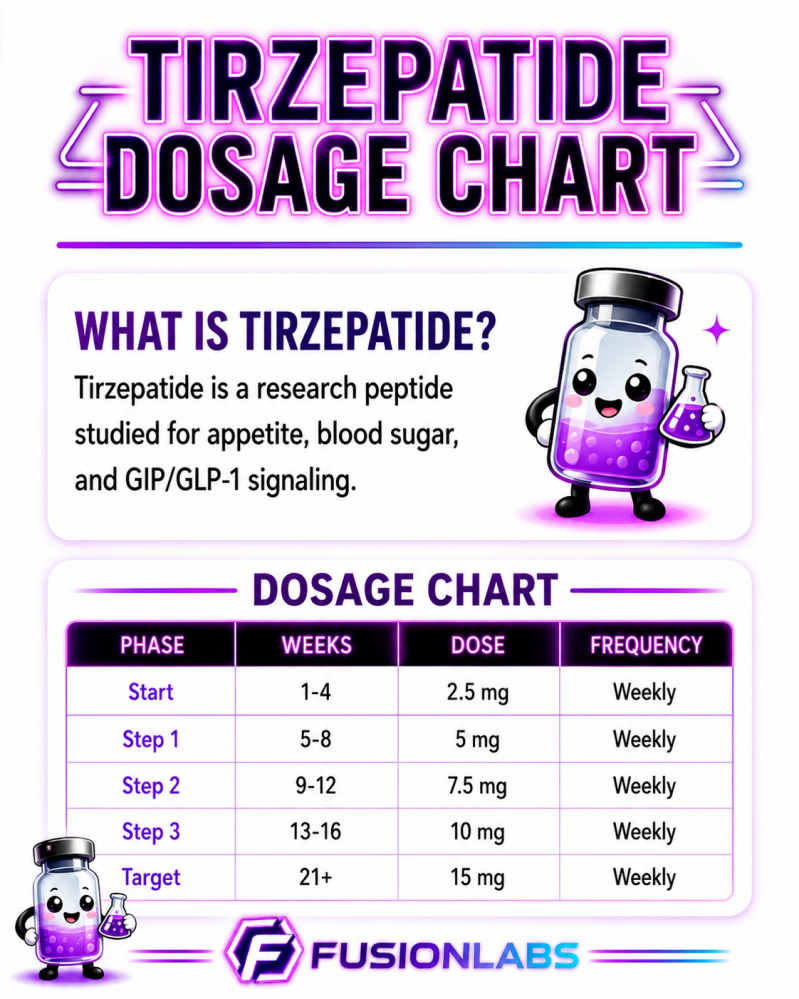
Tirzepatide dosage chart showing the phase-based weekly escalation schedule from 2.5 mg to 15 mg used as the dosing reference on this page.
How Tirzepatide Works
Tirzepatide is a 39-amino-acid synthetic peptide with a fatty-acid attachment. The fatty acid is what lets it bind to blood proteins and stay in circulation long enough for once-weekly dosing — its half-life is roughly 5 days. Once in circulation, it activates two receptors that the gut normally talks to after a meal: GIP and GLP-1.
GIP pathway
Tirzepatide activates GIP (glucose-dependent insulinotropic polypeptide) receptors at full strength, comparable to natural GIP. This helps the pancreas release insulin in response to food, improves how the body processes fat, and sends appetite-reducing signals to brain regions that GLP-1-only drugs do not reach.
GLP-1 pathway
Tirzepatide activates GLP-1 (glucagon-like peptide-1) receptors at about one-fifth the potency of natural GLP-1. This slows gastric emptying (so meals feel filling for longer), helps the pancreas tune insulin release, and suppresses appetite through brain signaling.
Why the combination matters
Adding GIP activation is what separates tirzepatide from semaglutide. In the head-to-head SURMOUNT-5 trial (NEJM, 2025), tirzepatide produced −20.2% body weight loss vs −13.7% for semaglutide at 72 weeks, with similar side-effect profiles. The dual approach also improved insulin sensitivity beyond what GLP-1 monotherapy delivered in SURPASS-2.
Who Tirzepatide Is For and Who Should Avoid It
Tirzepatide is FDA-approved for specific patient groups. People who do not match those groups, or who match a contraindication, should not use it without close clinician oversight — and in some cases, should not use it at all.
Approved patient groups
FDA-approved indications (as of June 2026)
Brand Indication Population
Mounjaro Type 2 diabetes Adults whose blood sugar is not controlled by diet, exercise, or other medications.
Zepbound Chronic weight management Adults with obesity (BMI ≥30) or overweight (BMI ≥27) plus at least one weight-related condition.
Zepbound Obstructive sleep apnea Adults with moderate-to-severe OSA who also have obesity.
Who should not use tirzepatide
Personal or family history of medullary thyroid carcinoma (MTC) or MEN 2
Boxed warning. Rodent studies showed thyroid C-cell tumors. Tirzepatide is contraindicated in this group.
History of pancreatitis
Pancreatitis has been reported. Patients with prior episodes should avoid tirzepatide unless a clinician decides the benefit clearly outweighs the risk.
Pregnancy
Tirzepatide is not recommended during pregnancy. Animal data show potential fetal harm. Stop tirzepatide at least 2 months before a planned pregnancy because of the long half-life.
Severe gastrointestinal disease (gastroparesis, severe IBD)
Tirzepatide slows gastric emptying. Patients with pre-existing severe motility issues may experience worse symptoms.
Type 1 diabetes
Tirzepatide is not a substitute for insulin. It is not approved for type 1 diabetes or for diabetic ketoacidosis.
Children and adolescents
Safety and effectiveness in patients under 18 have not been established outside of trial settings.
People using oral contraceptives
Slowed gastric emptying can reduce oral contraceptive absorption when starting tirzepatide. Backup contraception is recommended for the first 4 weeks of dosing and after every dose increase.
Tirzepatide Side Effects & Safety
Most tirzepatide side effects are digestive: nausea, diarrhea, vomiting, reduced appetite, and indigestion. They are usually worst during the weeks when the dose goes up and improve once the body adjusts. Below are the rates reported across the SURPASS and SURMOUNT trial programs.
Common side effects (SURPASS meta-analysis and SURMOUNT-1 reporting)
Side effect Approx. rate on tirzepatide Pattern
Nausea 17–22% Worst during dose escalation; improves at stable dose.
Diarrhea 13–16% Mild to moderate; rarely leads to discontinuation.
Vomiting 6–10% More common at 10 mg and 15 mg.
Decreased appetite 7–9% Often reported as a desired effect for weight loss.
Indigestion ~7% Often paired with slower digestion.
Injection-site reactions 3–7% Redness, mild itching, or local irritation.
Resting heart rate increase +2–4 bpm Modest. Larger increases are uncommon.
Source: meta-analyses across SURPASS; SURMOUNT-1 (NEJM 2022). Rates differ by trial and dose.
Side effects by dose
A meta-analysis of 10 trials (6,836 participants) found total GI event rates of 39% at 5 mg, 46% at 10 mg, and 49% at 15 mg. Discontinuation due to side effects ran from about 5% at 5 mg to about 10% at 15 mg.
Serious risks and warnings
Boxed warning: thyroid C-cell tumors
Rodent studies showed dose-dependent C-cell tumors. The clinical relevance in humans is uncertain, but use is contraindicated in patients with MTC history or MEN 2.
Pancreatitis
Acute pancreatitis has been reported. Stop tirzepatide if pancreatitis is suspected (severe abdominal pain that radiates to the back).
Gallbladder disease
Cholelithiasis and cholecystitis have been reported, consistent with rapid weight loss generally.
Hypoglycemia
Tirzepatide alone rarely causes low blood sugar, but the risk rises sharply when combined with insulin or sulfonylureas. Dose adjustments to those drugs are usually needed.
Acute kidney injury
Severe nausea and vomiting can lead to dehydration and AKI. Stay hydrated, especially during dose escalation. For practical support, review hydration, smaller meals, and GLP-1 supplement basics.
Hypersensitivity
Anaphylaxis and angioedema have been reported. Discontinue if a serious allergic reaction occurs.
Tirzepatide Timeline & What to Monitor
Tirzepatide builds up gradually. Because the half-life is about 5 days, with weekly dosing blood levels rise for the first 4 weeks before stabilizing. That is also why each dose step lasts at least 4 weeks; anything sooner evaluates the new dose before it has fully accumulated.
What people typically notice across the ladder
Numbers come from the SURMOUNT-1 trial and are population averages, not promises for any individual.
What is reasonable to monitor
Weight and waist circumference
Trial endpoints. Weekly weight and monthly waist measurements are simple at-home markers.
HbA1c (for T2D users)
Standard glycemic marker. SURPASS-2 showed up to −2.30% from baseline at 40 weeks.
Blood pressure
Tirzepatide modestly lowers systolic BP (~5 mmHg in SUMMIT). Patients on antihypertensives should track BP during escalation.
Resting heart rate
A 2–4 bpm rise is common. Larger sustained increases warrant a clinician check.
Symptoms of pancreatitis or gallbladder problems
Severe abdominal pain, back pain, fever, jaundice — stop and seek medical care.
Hydration and kidney symptoms
Especially during heavy nausea or vomiting.
Tirzepatide Clinical Evidence Context
Tirzepatide has one of the largest clinical trial programs of any incretin drug. The SURPASS program (type 2 diabetes) enrolled more than 19,000 participants across 10 trials. The SURMOUNT program (obesity) added thousands more, including the head-to-head SURMOUNT-5 trial against semaglutide. The summary below pulls the headline numbers from each pivotal study.
Pivotal Phase 3 trials
Trial Population Headline result
SURMOUNT-1 (NEJM 2022) 2,539 adults, obesity, no diabetes; 72 weeks −22.5% body weight at 15 mg; −21.4% at 10 mg; −16.0% at 5 mg.
SURMOUNT-5 (NEJM 2025) 751 adults, obesity, no diabetes; head-to- Tirzepatide head vs semaglutide; 72 weeks −20.2% vs semaglutide −13.7% (P<0.001).
SURPASS-2 (NEJM 2021) 1,879 adults with T2D vs semaglutide 1 mg; All tirzepatide doses superior. 40 weeks HbA1c up to −2.30%; up to 92% reached HbA1c <7%.
SURPASS-1 (Lancet 2021) 478 adults with T2D, monotherapy vs Up to 52% achieved HbA1c placebo; 40 weeks <5.7% (non-diabetic range).
SURPASS-5 (JAMA 2022) 475 adults with T2D + insulin glargine; HbA1c −2.11% to −2.34%; weight loss 40 weeks 5.4–8.8 kg.
SUMMIT (NEJM 2024) 731 patients with HFpEF + obesity; median 38% reduction in CV death or 104 weeks worsening heart failure (HR 0.62).
SURMOUNT-OSA (NEJM 2024) 469 adults with moderate-to-severe AHI reduced by 25.3– OSA + obesity; 52 weeks 29.3 events/hour; weight loss ~45–50 lbs.
Cardiovascular outcomes trial SURPASS-CVOT (NCT04255433) is ongoing.
Strongest weight-loss evidence
SURMOUNT-1 and the head-to-head SURMOUNT-5 are the gold-standard data points for tirzepatide weight loss. Both are large, multicenter, randomized, placebo- or semaglutide-controlled.
Strongest glycemic evidence
SURPASS-2 is the most cited head-to-head against semaglutide for HbA1c reduction in type 2 diabetes.
Cardiovascular evidence
SUMMIT showed a 38% reduction in cardiovascular death or worsening heart failure in obese HFpEF patients. SURPASS-CVOT will broaden that picture.
Evidence gaps
Long-term (5+ year) outcomes data is still being collected. Post-discontinuation weight regain has been observed in trial extensions; tirzepatide is treated as a chronic therapy.
Tirzepatide Regulatory Status
As of June 2026, tirzepatide is FDA-approved under two brand names. Mounjaro received FDA approval in May 2022 for adults with type 2 diabetes. Zepbound received approval in November 2023 for chronic weight management in adults with obesity or overweight plus a weight-related condition, and in December 2024 for moderate-to-severe obstructive sleep apnea in adults with obesity. Tirzepatide is the first and only FDA-approved dual GIP/GLP-1 receptor agonist.
Branded supply
Mounjaro and Zepbound are sold as single-use auto-injector pens (and Zepbound vials) by Eli Lilly. These are FDA-approved finished drug products.
Compounded supply
Compounded tirzepatide was widely available during the FDA-recognized shortage that ended in late 2024. Outside an active shortage, large-scale compounding is restricted; access depends on state pharmacy rules and 503A/503B compounding pathways. Quality and concentration vary by compounder.
Research-grade vials
Lyophilized research-grade tirzepatide is sold by laboratory chemical suppliers in 5/10/15/40/60 mg vials, labeled for research use only and not for human consumption. This is a separate, non-FDA supply chain.
Oral tirzepatide
There is no FDA-approved oral tirzepatide as of June 2026. "Tirzepatide pills" or "tirzepatide tablets" sold online are not FDA-approved formulations and lack established bioavailability data.
International status
Tirzepatide is approved in the EU, UK, Japan, and other markets under the Mounjaro and Zepbound names. The UK BNF lists it for both T2D and weight management.
Sources & Research
- 1. Jastreboff AM, Aronne LJ, Ahmad NN, et al. Tirzepatide Once Weekly for the Treatment of Obesity (SURMOUNT-1). New England Journal of Medicine (2022)
- 2. Aronne LJ, Horn DB, le Roux CW, et al. Tirzepatide as Compared with Semaglutide for the Treatment of Obesity (SURMOUNT-5). New England Journal of Medicine (2025)
- 3. Frias JP, Davies MJ, Rosenstock J, et al. Tirzepatide versus Semaglutide Once Weekly in Patients with Type 2 Diabetes (SURPASS-2). New England Journal of Medicine (2021)
- 4. Rosenstock J, Wysham C, Frias JP, et al. Efficacy and safety of a novel dual GIP and GLP-1 receptor agonist tirzepatide in patients with type 2 diabetes (SURPASS-1). Lancet (2021)
- 5. Dahl D, Onishi Y, Norwood P, et al. Effect of Subcutaneous Tirzepatide vs Placebo Added to Titrated Insulin Glargine on Glycemic Control in Patients With Type 2 Diabetes (SURPASS-5). JAMA (2022)
- 6. Packer M, Zile MR, Kramer CM, et al. Tirzepatide for Heart Failure with Preserved Ejection Fraction and Obesity (SUMMIT). New England Journal of Medicine (2024)
- 7. Malhotra A, Grunstein RR, Fietze I, et al. Tirzepatide for the Treatment of Obstructive Sleep Apnea and Obesity (SURMOUNT-OSA). New England Journal of Medicine (2024)
- 8. U.S. Food and Drug Administration Mounjaro (tirzepatide) injection — Prescribing Information and Approval History. FDA Drug Approvals (2022)
- 9. U.S. Food and Drug Administration Zepbound (tirzepatide) injection — Prescribing Information and Approval History. FDA Drug Approvals (2023)
- 10. Sinha R, Papamargaritis D, Sargeant JA, Davies MJ. Efficacy and Safety of Tirzepatide in Type 2 Diabetes and Obesity Management (meta-analysis of SURPASS). Journal of Obesity & Metabolic Syndrome (2023)
- 11. Coskun T, Sloop KW, Loghin C, et al. LY3298176, a novel dual GIP and GLP-1 receptor agonist for the treatment of type 2 diabetes mellitus: From discovery to clinical proof of concept. Molecular Metabolism (2018)
- 12. ClinicalTrials.gov A Study of Tirzepatide (LY3298176) on Cardiovascular Events in Participants With Type 2 Diabetes (SURPASS-CVOT, NCT04255433). ClinicalTrials.gov (2026)