
Retatrutide Protocol Guide - Dosing, Reconstitution & Safety
Step-by-step retatrutide research dosing reference: 1-12 mg once-weekly titration, full reconstitution chart, supplies-by-cycle math, Phase 3 results, and the dysesthesia safety signal.
Retatrutide Quick Start
Retatrutide is a research peptide being studied as a once-weekly shot for weight and metabolic outcomes. Researchers care about it because it acts on three hormone pathways at once: GLP-1, GIP, and glucagon. In plain English, that means it touches appetite, blood sugar, and how fast the body burns calories at the same time.
This page covers the typical research-protocol structure: the 1 mg start, the slow titration up to 12 mg, how to reconstitute the vial, how to plan supplies, and what the Phase 2 and Phase 3 trial data show. It is an educational reference. It is not medical advice and not a personal treatment plan.
Route
Subcutaneous injection, once per week, on the same day each week.
Schedule
Climb every 4 weeks: 1 mg -> 2 mg -> 4 mg -> 6 mg -> 9 mg -> 12 mg.
Measure
U-100 insulin syringes; vial size and BAC water volume set how many units equal each dose.
Supplies
Reconstituted vial, BAC water, U-100 syringes, alcohol swabs, calculator for unit math.
Research status
Investigational; not FDA-approved as of June 2026.
Disclaimer
This page is an educational research reference. It is not medical advice, not a treatment plan, and not a recommendation to use retatrutide outside of a clinical trial or qualified medical care.
Retatrutide Dosing Protocol & Schedule
The retatrutide dosing protocol is built as a slow climb, not a dose to jump into. The starting dose in clinical trials is 1 mg once weekly. The titration schedule then steps up every 4 weeks so the body can adjust before higher doses are reached.
There are two main schedules in the published research. Phase 2 (NEJM, 2023) used 1 -> 2 -> 4 -> 8 -> 12 mg with no 6 mg step. Phase 3 TRIUMPH adds an intermediate 6 mg step and treats 4 mg, 9 mg, and 12 mg as target maintenance doses depending on the trial arm.
Phase 3 TRIUMPH titration (current standard)
Phase 3 TRIUMPH retatrutide titration schedule
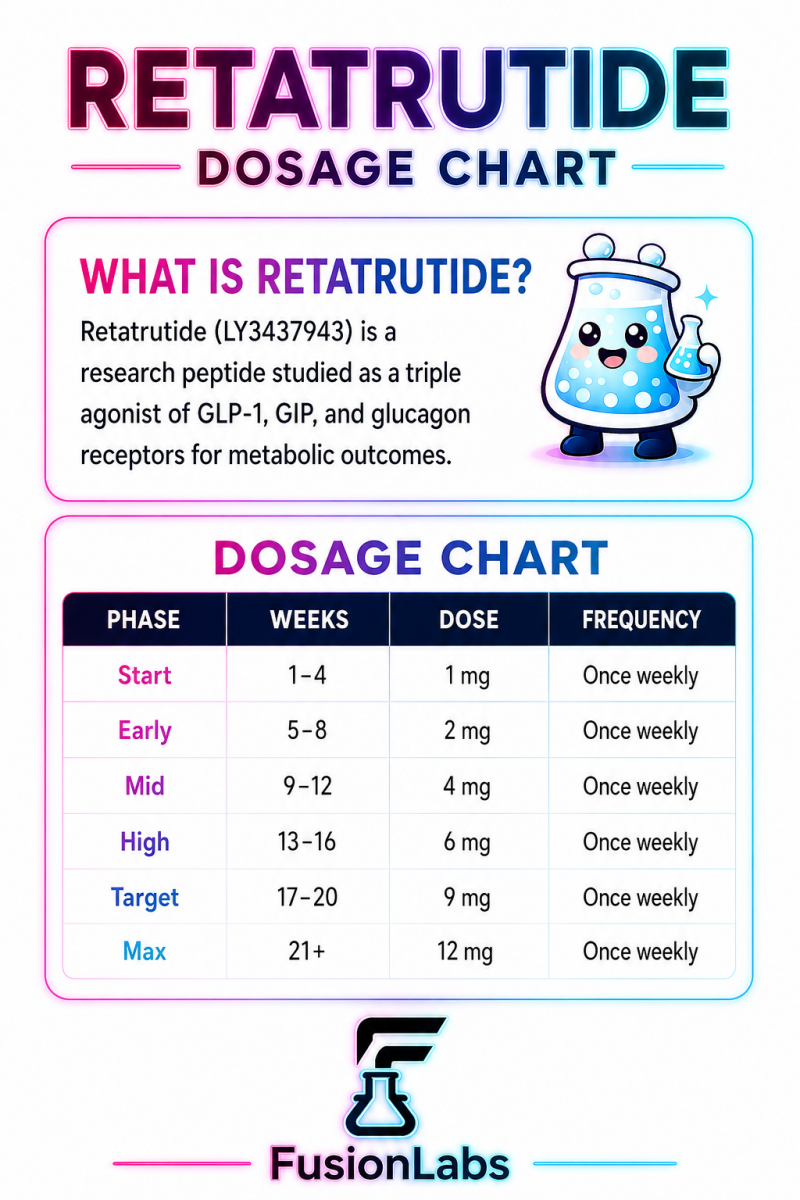
Phase Weeks Weekly Dose Notes
Initiation Weeks 1-4 1 mg Starting dose Limited weight effect expected; the goal is tolerance, not results.
Early escalation Weeks 5-8 2 mg First step up. GI side effects (nausea) may begin.
Mid escalation Weeks 9-12 4 mg Appetite suppression Weight loss start accelerating usually becomes noticeable..
High escalation Weeks 13-16 6 mg Phase 3 added this intermediate step Phase 2 jumped from 4 mg straight to 8 mg.
Therapeutic range Weeks 17-20 9 mg Phase 3 target dose for many TRIUMPH arms.
Maximum studied Weeks 21+ 12 mg Maximum dose studied. 24.2% weight loss at 48 weeks (Phase 2). 28.7% at 68 weeks (Phase 3 TRIUMPH-4).
Data: Jastreboff et al., NEJM 2023 (Phase 2); Eli Lilly TRIUMPH-4 topline, December 11, 2025 (Phase 3).
Phase 2 NEJM titration (still common in research)
Phase 2 retatrutide titration schedule
Phase Weeks Weekly Dose
Initiation Weeks 1-4 1 mg
Early escalation Weeks 5-8 2 mg
Mid escalation Weeks 9-12 4 mg
High escalation Weeks 13-16 8 mg
Maximum Weeks 17+ 12 mg
Source: Jastreboff et al., NEJM 2023. Phase 2 trial protocol, 48 weeks.
Cycle guidelines
Approach Duration Review Point Best For
Phase 2 reference 48 weeks Every 4 weeks at each dose step Matches the original NEJM trial structure
Phase 3 TRIUMPH 68-72 weeks Every 4 weeks; review at 4 mg, Mirrors current Phase 3 reference 9 mg, 12 mg maintenance arms
Slow titration Add 2-4 weeks per dose Each dose step When nausea, vomiting, or step when GI symptoms diarrhea is hard to tolerate persist
Trial protocols allowed participants to stay at the current dose for an extra 2-4 weeks when GI side effects were significant. This is not a personal recommendation.
Titration pacing matters
In the Phase 2 NEJM trial, GI side effect rates nearly doubled when participants jumped to 8 mg instead of climbing gradually from 1-2 mg. Slower titration was the main lever for adherence.
Peptide Vials (10 mg vials)
10 mg vial is the most common research format. With 2.0 mL BAC water, concentration is 5 mg/mL.
Cycle length Planning note
4 weeks
1 vial
4 doses of 1 mg = 4 mg total; one 10 mg vial covers easily.
8 weeks
2 vials
Through Week 8 (1 mg + 2 mg phases) = 12 mg total; round up for losses.
12 weeks
3 vials
Through 4 mg phase = 28 mg total; 3 vials gives margin.
16 weeks
6 vials
Through 6 mg phase = 52 mg total; 6 x 10 mg vials covers it.
24 weeks
14 vials
Through 12 mg first month = 136 mg total; 14 x 10 mg vials gives margin.
Peptide Vials (24 mg vials)
24 mg vial is a common large-format option. With 2.4 mL BAC water, concentration is 10 mg/mL.
Cycle length Planning note
8 weeks
1 vial
Through Week 8 = 12 mg total; one 24 mg vial covers it with margin.
16 weeks
3 vials
Through 6 mg phase = 52 mg total; 3 x 24 mg vials covers with margin.
24 weeks
6 vials
Through 12 mg first month = 136 mg total.
Insulin Syringes (U-100, 0.3 mL or 0.5 mL)
One syringe per weekly injection. 0.3 mL syringes work well at lower doses; 0.5 mL syringes are easier when the draw is closer to 0.40-0.80 mL.
Cycle length Planning note
4 weeks
4 syringes
1 syringe per weekly injection.
8 weeks
8 syringes
1 syringe per weekly injection.
12 weeks
12 syringes
1 syringe per weekly injection.
24 weeks
24 syringes
1 syringe per weekly injection; recommend a 100-count box.
Bacteriostatic Water (10 mL bottles)
Use 2.0 mL per 10 mg vial or 2.4 mL per 24 mg vial. Add a margin for spills and re-dos.
Cycle length Planning note
8 weeks
1 x 10 mL bottle
2 x 10 mg vials use 4.0 mL; 1 x 24 mg vial uses 2.4 mL. One bottle covers easily.
16 weeks
2 x 10 mL bottles
6 x 10 mg vials use 12.0 mL; 3 x 24 mg vials use 7.2 mL. Two bottles preferred for margin.
24 weeks
3 x 10 mL bottles
14 x 10 mg vials use 28.0 mL; 6 x 24 mg vials use 14.4 mL. Third bottle gives reconstitution margin.
Retatrutide Dosage Chart
This retatrutide dosage chart summarizes the standard once-weekly titration schedule from 1 mg up to 12 mg, with dose escalation shown by week range.
How Retatrutide Works
Retatrutide acts on three hormone pathways at the same time: GLP-1, GIP, and glucagon. Most other research peptides in this class only act on one or two. The simplest way to picture it: one pathway helps the body feel full, one helps it handle blood sugar and stored fuel, and one may push energy use up.
GLP-1 receptor (the 'feel full' lever)
This is the same general pathway used by semaglutide. It slows digestion and helps people feel full longer, which is one reason retatrutide can reduce appetite. Researchers coming from GLP-1 work will recognize this part of the mechanism.
GIP receptor (the 'handle fuel' lever)
GIP is short for glucose-dependent insulinotropic polypeptide. It is part of why retatrutide is studied as a broader metabolic compound rather than only an appetite tool. In plain English, it helps the body manage blood sugar and how it stores energy.
Glucagon receptor (the 'burn more' lever)
This is the third lever, and it is what separates retatrutide from tirzepatide. Glucagon receptor activity is linked to higher energy expenditure and fat oxidation. It is a likely reason why the weight loss and liver fat numbers in trials look stronger than older single- or dual-pathway compounds.
Structurally, retatrutide is a 39-amino acid single-chain peptide with a C20 fatty diacid attachment. That attachment helps it bind to albumin in the blood. The longer circulation time is the technical reason for the ~6-day half-life and once-weekly dosing
Who Retatrutide Is For and Who Should Avoid It
Retatrutide is currently studied in adults with obesity, adults with type 2 diabetes, and adults with weight-related conditions like knee osteoarthritis, sleep apnea, and metabolic dysfunction-associated steatotic liver disease (MASLD). It is not approved for any use as of June 2026, so eligibility is defined by the trials, not by a label.
Trial exclusion patterns
Phase 2 and Phase 3 retatrutide trials commonly excluded participants with a history of pancreatitis, medullary thyroid carcinoma, multiple endocrine neoplasia syndrome type 2 (MEN 2), severe gastroparesis, recent major cardiovascular events, severe kidney impairment, type 1 diabetes (in the obesity studies), and pregnancy or breastfeeding. These exclusions follow the same general pattern used in semaglutide and tirzepatide trials.
Pregnancy, breastfeeding, and trying to conceive
Retatrutide has not been studied in pregnant or breastfeeding people. Trials require effective contraception. Anyone in those situations should not be considering retatrutide outside qualified medical care.
Conditions that need clinician oversight
Personal or family history of medullary thyroid carcinoma or MEN 2.
History of pancreatitis or gallbladder disease.
Severe kidney or liver disease.
Diabetic retinopathy or active retinal disease.
Severe GI conditions (gastroparesis, IBD flare).
Active cardiovascular disease, recent heart attack, or unstable angina.
Use of insulin or sulfonylureas (hypoglycemia risk).
Clinician oversight matters
Retatrutide is investigational. The points above are research-population exclusion patterns, not personal medical advice. Anyone in these categories should talk to a qualified clinician.
Retatrutide Side Effects & Safety
Retatrutide side effects look broadly similar to other incretin-based research compounds. The simplest way to think about them is in two buckets: stomach symptoms during dose escalation, and a separate skin-sensation signal at the highest dose in Phase 3.
Common gastrointestinal effects (Phase 2 NEJM)
Retatrutide GI side effects at 12 mg in the Phase 2 NEJM trial
Effect Rate at 12 mg
Nausea Up to 25%
Diarrhea Up to 23%
Vomiting Up to 26%
Constipation Up to 16%
GI symptoms were most common during dose escalation and were usually mild to moderate. Source: Jastreboff et al., NEJM 2023.
Dysesthesia signal (Phase 3)
TRIUMPH-4 topline results, released December 11, 2025, reported dysesthesia in about 20.9% of participants at the highest dose. Dysesthesia means unusual skin sensitivity, tingling, or tenderness to touch. It is the most distinct safety signal that separates retatrutide from older GLP-1 class compounds.
Cardiovascular and metabolic signals
Resting heart rate increased by about 5-10 bpm on average. It peaked near week 24 and eased by weeks 36-48.
Phase 2 reported no increase in serious cardiovascular events.
Temporary ALT/AST elevations occurred in a minority of participants and were generally tied to dose increases.
Injection site reactions (redness, itching, small nodules) were observed in roughly 5-15% of participants.
Discontinuation
In Phase 2, 6-16% of participants stopped because of adverse events versus 0% on placebo. Slow titration improved adherence. That is the main practical reason the protocol uses a 4-week climb at each step.
Quality control matters
Retatrutide is research-grade and not standardized for human use. COA verification, batch testing, and storage matter. Bad reconstitution, repeated freeze-thaw cycles, or contaminated BAC water can show up as injection site issues that look like side effects.
Retatrutide Timeline & What to Monitor
Retatrutide builds up slowly. Steady-state plasma concentrations land after about 4-5 half-lives, or roughly 4 weeks at each dose step. That is why each titration phase is 4 weeks long: it gives the dose time to reach a steady level before the next step up.
Half-life and steady state
Retatrutide's half-life is about 6 days (around 144 hours). After stopping, it takes roughly 5 half-lives (about 30 days) for the compound to clear. The 6-day half-life is the technical reason for once-weekly dosing.
Dose-by-dose weight loss in Phase 2 (NEJM)
Phase 2 NEJM weight loss by dose, 24 and 48 weeks
Dose 24 weeks 48 weeks
1 mg -7.2% -8.7%
4 mg -12.9% -17.5%
8 mg -15.7% -22.8%
12 mg -17.5% -24.2%
Placebo -1.6% -2.1%
Source: Jastreboff et al., NEJM 2023. 100% of 12 mg participants lost at least 5%; 83% lost at least 15%.
What participants typically asked about
Nausea, vomiting, and diarrhea during the first few weeks of each dose step; PepPal's GLP-1 companion supplement checklist covers protein, fiber, electrolytes, and lab-driven nutrient support.
Heart rate (resting heart rate often went up early and eased later).
Liver enzymes (ALT/AST) when dose increases happened.
Skin sensitivity at the highest dose (the dysesthesia signal).
Weight trajectory - whether it was still moving at the end of the cycle.
Reasonable markers to track
Weekly body weight on the same scale at the same time of day.
Resting heart rate (a basic wearable or fingertip pulse oximeter is enough).
Routine labs (CBC, CMP including ALT/AST, lipid panel, fasting glucose, HbA1c) before starting and on a regular schedule under clinician oversight.
Notes on GI symptoms by dose phase. This is the single most useful data point for deciding when to stay at a dose.
What cannot be promised
Trial averages are not personal predictions. Phase 2 saw -24.2% at 48 weeks at 12 mg, but individual results varied widely. Phase 3 added a dysesthesia signal that did not appear at the same rate in earlier studies. Read this as range, not guarantee.
Retatrutide Clinical Evidence Context
Retatrutide has the strongest evidence in obesity, with Phase 3 data now available in obesity without diabetes, obesity with knee osteoarthritis, and type 2 diabetes. Additional Phase 3 readouts across the TRIUMPH and TRANSCEND-T2D programs are expected through 2026 and 2027.
Human evidence - Phase 3 TRIUMPH-1 (Eli Lilly, May 21, 2026)
2,339 adults with obesity or overweight without diabetes. The 12 mg dose produced 28.3% average body weight loss at 80 weeks, and a higher-BMI two-year subgroup reached 30.3% average loss at 104 weeks. Results are topline only; full peer-reviewed data has not been published yet.
Human evidence - Phase 3 TRIUMPH-4 (Eli Lilly, December 11, 2025)
Adults with obesity and knee osteoarthritis. Average 28.7% body weight loss at 68 weeks at the 12 mg dose (about 71.2 lbs / 32.3 kg average loss). WOMAC pain score improved by 4.5 points. Dysesthesia reported in about 20.9% at the highest dose.
Human evidence - Phase 3 TRANSCEND-T2D-1 (Eli Lilly, March 19, 2026)
537 adults with type 2 diabetes, randomized 1:1:1:1 to retatrutide 4, 9, or 12 mg or placebo. A1C reduction of 1.7-2.0% across doses at 40 weeks. Average 16.8% body weight loss at 12 mg (about 36.6 lbs). No weight plateau reached at 40 weeks. Detailed results scheduled for the American Diabetes Association Scientific Sessions, June 2026.
Human evidence - Phase 2 NEJM (Jastreboff et al., 2023)
338 adults with obesity but no diabetes. 12 mg: -24.2% body weight at 48 weeks. 8 mg: -22.8%. 4 mg: -17.5%. 100% of 8 mg and 12 mg participants lost at least 5%; 83% in the 12 mg arm lost at least 15%.
Human evidence - Phase 2 type 2 diabetes (Rosenstock et al., Lancet 2023)
Adults with type 2 diabetes, 36 weeks. Up to -16.9% weight loss. HbA1c improved by -2.2%. 82% reached HbA1c at or below 6.5%.
Human evidence - Phase 2 MASLD substudy (Sanyal et al., Nature Medicine 2024)
Adults with MASLD and at least 10% liver fat. Up to 82% relative reduction in liver fat at 24 weeks.
Pharmacokinetics (Coskun et al., Cell Metabolism 2022)
Phase 1 PK data established the ~6-day half-life and once-weekly dosing rationale. Albumin binding via the C20 fatty diacid attachment is the technical mechanism.
Evidence boundary
Retatrutide is investigational. Phase 3 readouts are landing on a rolling basis, but FDA approval has not happened as of June 2026. Treat current numbers as the best available evidence, not a final label.
Retatrutide Protocol Mistakes & Troubleshooting
Most retatrutide protocol issues fall into a small number of buckets. Use this as a quick checklist when something feels off.
Missed dose
Clinical trial protocols allowed a scheduled weekly dose missed by 5 days or fewer to be taken when remembered. After more than 5 days, the missed dose was skipped and dosing resumed on the next scheduled day without doubling up. This is trial-protocol reporting, not a personal medical recommendation.
Cloudy or off-color vial
Reconstituted retatrutide should be clear. A cloudy, particulate, or strongly off-color solution is a sign to stop using that vial and check storage, BAC water, and reconstitution technique.
Wrong BAC water volume
Adding too much or too little BAC water changes the concentration and the syringe units per dose. If the volume was off, recalculate using the actual amount added rather than the planned amount. Use the reconstitution calculator to redo the math.
Side effects feel too strong
Trial protocols allowed staying at the current dose for an extra 2-4 weeks when GI side effects were significant. Slowing the climb is the main lever. Splitting the weekly dose across two injections (microdosing-style) is a research-community pattern but is not a Phase 2 or Phase 3 standard.
Injection site reaction
Small redness, itching, or a tender bump at the injection site is common. Persistent lumps suggest the same area is being used too often. Rotating sites by roughly an inch each week is commonly reported to reduce lump formation. Persistent or growing reactions need a clinician.
Storage mistake
If reconstituted vials sat at room temperature for an extended period, or went through repeated freeze-thaw cycles, the safer choice is to discard the vial. Peptide quality and sterility cannot be visually verified.
When to seek medical care
Severe persistent vomiting, signs of pancreatitis (severe upper-abdominal pain, often radiating to the back), severe allergic reactions, or any reaction that is getting worse rather than better are reasons to stop and seek qualified medical care. This page is not emergency advice.
Sources & Research
- 1. Jastreboff AM, Kaplan LM, Frias JP, et al. Triple-Hormone-Receptor Agonist Retatrutide for Obesity - A Phase 2 Trial. New England Journal of Medicine (2023)
- 2. Rosenstock J, Frias JP, Jastreboff AM, et al. Retatrutide, a GIP, GLP-1 and glucagon receptor agonist, for people with type 2 diabetes: a randomised, double-blind, placebo and active-controlled, parallel-group, phase 2 trial. The Lancet (2023)
- 3. Sanyal AJ, Kaplan LM, Frias JP, et al. Triple hormone receptor agonist retatrutide for metabolic dysfunction-associated steatotic liver disease: a randomized phase 2a trial. Nature Medicine (2024)
- 4. Coskun T, Urva S, Roell WC, et al. LY3437943, a novel triple glucagon, GIP, and GLP-1 receptor agonist for glycemic control and weight loss: From discovery to clinical proof of concept. Cell Metabolism (2022)
- 5. Eli Lilly and Company Lilly's triple agonist, retatrutide, delivered weight loss of up to an average of 71.2 lbs along with substantial relief from osteoarthritis pain in first successful Phase 3 trial. PR Newswire / Eli Lilly press release (TRIUMPH-4 topline) (2025)
- 6. Eli Lilly and Company Lilly's triple agonist, retatrutide, delivered powerful weight loss in pivotal Phase 3 obesity trial. PR Newswire / Eli Lilly press release (TRIUMPH-1 topline) (2026)
- 7. Eli Lilly and Company Lilly's triple agonist, retatrutide, demonstrated significant reductions in A1C and weight in first Phase 3 trial for treatment of type 2 diabetes. PR Newswire / Eli Lilly press release (TRANSCEND-T2D-1 topline) (2026)
- 8. Eli Lilly and Company What to know about retatrutide. Lilly.com (2026)
- 9. ClinicalTrials.gov TRANSCEND-T2D-1: A Study of Retatrutide (LY3437943) in Adult Participants With Type 2 Diabetes (NCT06354660). ClinicalTrials.gov (2026)
- 10. ClinicalTrials.gov TRIUMPH-4: A Study of Retatrutide (LY3437943) in Participants With Obesity and Knee Osteoarthritis (NCT05929066). ClinicalTrials.gov (2025)
- 11. Tucker ME. Triple Agonist Retatrutide Reduces A1c, Weight in T2D. Medscape (2026)
- 12. U.S. Food and Drug Administration Statement on FDA's review of compounded versions of brand-name GLP-1 drugs and reports of online sellers marketing unapproved peptides. FDA.gov consumer guidance (2025)