GHK-Cu Peptide Dosing Guide: Skin, Hair & Safety (2026)
An evidence-based GHK-Cu protocol guide covering dosing structure, injectable vs topical use, cycle length, and safety considerations for this copper peptide.
GHK-Cu Quick Start
GHK-Cu (glycyl-L-histidyl-L-lysine copper) is a small copper-binding peptide that occurs naturally in human plasma. Levels are roughly 200 ng/mL around age 20 and fall to about 80 ng/mL by age 60. That decline is part of why GHK-Cu became a target for skin, hair, and wound-healing research.
Most clinical evidence is topical. Most community use is split between topical creams or serums and subcutaneous injection. This guide covers both routes side by side so the math, supplies, and evidence boundaries stay separate instead of blurring together.
Routes
Subcutaneous (SubQ) injection and topical formulations are the two main research-use routes.
Common range
Community discussions reference 1-2 mg per day SubQ or 1-3% topical formulations.
Measure
For injectable formats, vial size and reconstitution volume drive every draw calculation.
Supplies
Plan vials, BAC water, U-100 insulin syringes, and alcohol swabs by cycle length.
Status
Not FDA-approved. Injectable GHK-Cu was removed from FDA Category 2 on April 15, 2026.
Disclaimer
This page is an educational research reference and is not medical advice. Dosing context describes common community-derived research planning, not a personal protocol. Speak with a qualified clinician before any peptide use.
GHK-Cu Dosing Protocol & Schedule
GHK-Cu is researched through two very different routes: subcutaneous injection of a reconstituted vial and topical application of a cream, serum, or microneedling-adjacent formulation. The route changes the dose, the cycle length, and the supplies you need. Choose the tab that matches the format you are researching.
GHK-Cu Protocol Formats
Choose the format you are researching to see route-specific dosing notes.
Injectable (SubQ)
Subcutaneous injection of reconstituted GHK-Cu from a research-grade vial.
Common research-planning range
Community discussions and protocol-style references commonly describe 1-2 mg per day SubQ for a 4-8 week cycle. Lower starting points (around 1 mg/day) are typical for new research planning, and 2 mg/day is the high end most references cite. This is not a dosing recommendation.
Common Injectable Cycle Patterns
Approach: Conservative start
Daily dose: 1.0 mg
Schedule: 5 days on / 2 off
Cycle length: 4 weeks
Apporoach: standard
Daily dose:1.0-1.5 mg
Schedule: Daily 4-6 weeks
Higher end: 1.5-2.0 mg
Cycle length: Daily 6-8 weeks
Educational reference. No human RCT has confirmed an optimal injectable schedule for cosmetic or wound-healing endpoints.
Subcutaneous injections are typically rotated across the abdomen, outer thigh, and back of the upper arm. Many community references include 2-4 week off-periods between cycles to allow fresh evaluation, although the rationale is community-derived rather than trial-validated.
Evidence boundary
No published human randomized trial has evaluated long-term injectable GHK-Cu for skin, hair, or wound endpoints. The strongest human evidence is topical, including the Leyden 2002 photoaging trial and a 2023 IRB-approved 21-woman topical NEEL gel study reporting an average 28% increase in skin collagen density at 3 months.
Topical
Cream, serum, or compounded topical formulations applied to skin or scalp.
Common topical formulation strengths
Cosmetic and compounded topical GHK-Cu products typically range from 1% to 3% by weight. Higher-end formulations sometimes cite 4-5%, but irritation reports rise with concentration. The 12-week study by Leyden and colleagues that anchors most topical evidence used a once- or twice-daily facial application.
Common Topical Application Patterns
Use case Concentration Frequency Cycle length
Facial anti-aging (community use) 1-2% Once or twice daily 8-12 weeks
Scalp / hair-research interest 1-3% Daily 12+ weeks ongoing
Compounded post-procedure 1-2% Per clinician guidance Per clinician guidance
Topical concentrations are typically expressed as percent weight. A 1% serum is roughly 10 mg of GHK-Cu per gram of finished formulation.
Topical workflows are widely used because Copper Tripeptide-1 (the cosmetic name) is an established cosmetic ingredient. The clinical evidence base for topical use is stronger than for injection.
Evidence boundary
No published human randomized trial has evaluated long-term injectable GHK-Cu for skin, hair, or wound endpoints. The strongest human evidence is topical, including the Leyden 2002 photoaging trial and a 2023 IRB-approved 21-woman topical NEEL gel study reporting an average 28% increase in skin collagen density at 3 months.
GHK-Cu Reconstitution Guide
Reconstituting GHK-Cu is straightforward, but the route changes what you do with the reconstituted liquid. Injectable workflows draw from the vial directly. Topical workflows mix the reconstituted GHK-Cu into a base cream or serum.
Common Vial Sizes and Concentration
Vial size: 50 mg
Bac water: 2.0 mL
Concentration: 25.0 mg/mL 0.04 mL =
1 mg draw (U-100): 4 units
__________________________________________________________
Vial size: 50 mg
Bac water: 2.5 mL
Concentration: 20.0 mg/mL 0.05 mL =
1 mg draw (U-100): 5 units
_________________________________________________________
Vial size: 50mg
Bac water:3.0 mL
Concentration: 16.67 mg/mL 1mL
1 mg draw (U-100) : 12 units
__________________________________________________________
Vial size: 100 mg
Bac water :3.0 mL
Concentration: 33.3 mg/mL 0.03 mL =
1 mg draw (U-100): 3 units
Vial size: 100 mg
Bac water: 5.0 mL
Concentration :20.0 mg/mL 0.05 mL =
1 mg draw ( U-100): 5 units
Pick a reconstitution volume that produces a draw you can read cleanly on a U-100 syringe.
Standard Reconstitution Steps
01
Inspect the vial
Check label, supplier, and lot number. The lyophilized powder for GHK-Cu often appears off-white to pale blue depending on copper content and supplier process.
02
Prepare your supplies
Lay out one BAC water vial, one syringe for reconstitution, one syringe for the dose, and at least two alcohol swabs.
03
Swab both stoppers
Wipe the BAC water stopper and the GHK-Cu vial stopper with alcohol swabs and let them dry.
04
Draw bacteriostatic water
Draw the planned reconstitution volume from the BAC water vial.
05
Inject down the side of the vial
Aim the BAC water against the inner glass wall, not directly onto the powder. This protects the peptide from foaming and shear.
06
Swirl, do not shake
Roll the vial gently between your hands until the powder fully dissolves. The solution should look clear with a faint blue tint from the copper complex.
07
Store under refrigeration
Keep reconstituted GHK-Cu refrigerated and protected from light. Use within the supplier-stated beyond-use window.
Topical mixing note
For topical workflows, some compounded protocols mix reconstituted GHK-Cu into an unscented base cream or a hyaluronic-acid serum to hit a target percent. A 1% topical from a 100 mg vial reconstituted in 5 mL would mean roughly 0.5 mL (10 mg) blended into 1 g of finished base. Speak with a compounding pharmacist for exact formulation guidance.
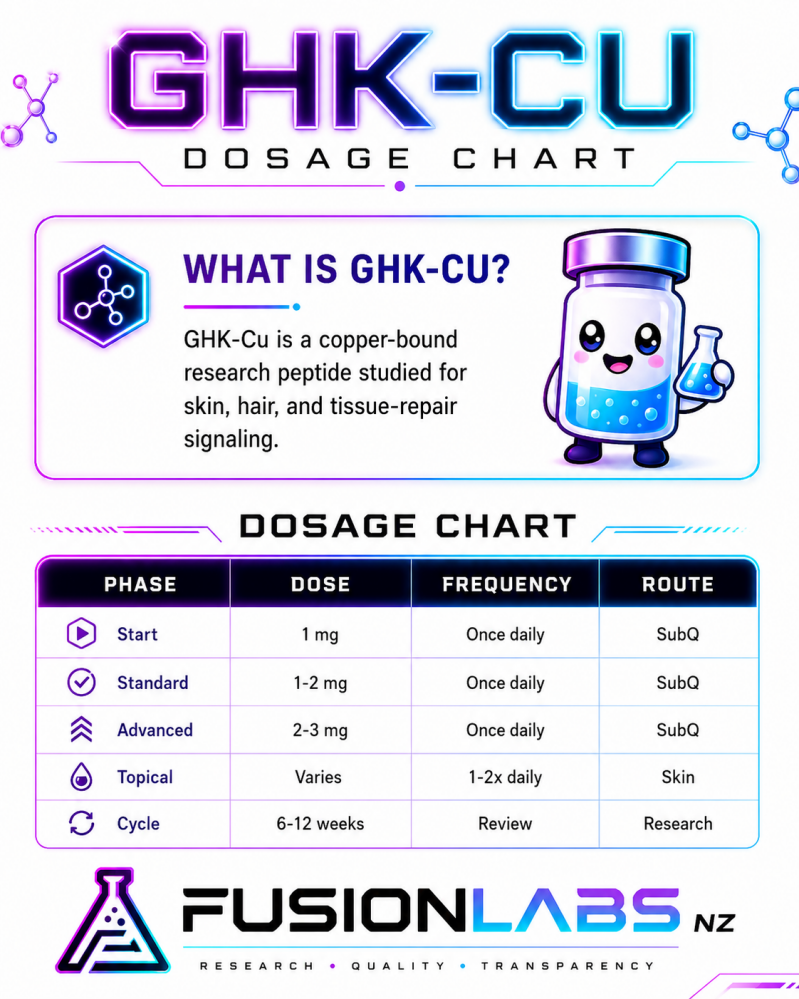
GHK-Cu Dosage Chart
This GHK-Cu dosage chart summarizes common injectable cycle patterns from a conservative 1.0 mg start through a higher-end 1.5-2.0 mg daily research-planning range.
How GHK-Cu Works
GHK-Cu does two things at once. It carries copper into cells where copper-dependent enzymes need it, and the GHK fragment itself acts as a signaling peptide that influences gene expression in fibroblasts and other tissue cells. That dual role is part of why the research base touches so many systems: skin, hair follicles, wound beds, lung, gut, and bone in animal and cell models.
Mechanistically, GHK-Cu has been shown to stimulate collagen and elastin synthesis in dermal fibroblasts, increase decorin (a small proteoglycan that helps regulate collagen organization), and influence matrix metalloproteinases and their inhibitors. Broad gene-mapping work led by Pickart and colleagues reported modulation of thousands of genes, with roughly a third of human gene patterns shifting toward expression states associated with younger or healthier tissue.
The mechanism story is broad, but most of it is built on cell and animal models. The strongest human-level translation is in topical skin biology. Injectable systemic translation is still mostly indirect.
GHK-Cu Side Effects & Safety
GHK-Cu has a long topical safety record and a shorter, mostly anecdotal injectable record. Side-effect patterns are different by route.
Topical effects
Most reported topical effects are mild and local: redness, tingling, dryness, or transient irritation at the application site, typically more common with concentrations above 4%. Combining GHK-Cu with strong actives like high-strength retinoids or low-pH acids in the same routine can increase irritation. Most cosmetic sources recommend rotating actives instead of layering them.
Injectable effects
Reported injectable effects are mostly local: redness, mild swelling, transient warmth, or a slight blue-tinted bruise from the copper complex. Systemic effects are rare in user reports but are not well characterized in published trials.
Theoretical risks
Long-term or high-frequency use raises theoretical concerns about copper accumulation. GHK-Cu also stimulates both collagen synthesis and matrix metalloproteinases that break collagen down, so unbalanced or excessive use could in principle disrupt extracellular-matrix homeostasis. These risks are theoretical, not documented in human trials, but they are reasons community references include cycle off-periods.
Quality-control risk
Research-use peptide vials vary in purity, copper content, and reconstitution stability. A trustworthy COA from an independent lab is the best buyer-side check. Avoid vials with no batch-matched COA, no copper content data, or unclear supplier provenance.
GHK-Cu Timeline & What to Monitor
Topical clinical trials of GHK-Cu generally measured endpoints at 8-12 weeks. The Leyden 2002 facial-cream trial reported skin density, thickness, fine lines, and laxity changes at 12 weeks. The 2023 NEEL gel IRB study reported an average 28% increase in skin collagen density at 3 months. Injectable timelines are not well characterized in published trials, but community planning typically uses 4-8 week cycles for the same reason: change in skin or hair quality is slow to appear.
Common Endpoints by Route
Topical timelines are anchored to published trials. Injectable timelines are anchored to community planning, not RCTs.
Reasonable things to monitor over a cycle include before-and-after photos in consistent lighting, irritation or injection-site reactions, and any subjective changes in healing speed. Do not interpret photographic improvement as proof of mechanism in your own case.
GHK-Cu Clinical Evidence Context
The cleanest way to think about GHK-Cu evidence is by route. Topical evidence is stronger and includes IRB-approved human trials. Injectable evidence is mostly preclinical with strong mechanism data, plus community use.
Strongest human evidence (topical)
The Leyden 2002 photoaging trial in 71 women applied a GHK-Cu facial cream for 12 weeks and reported measurable improvements in skin density, thickness, fine lines, and laxity. A companion eye-cream study in 41 women compared GHK-Cu cream to placebo and vitamin K and reported greater periorbital improvement.
Recent human topical evidence
A 2023 IRB-approved 21-woman topical trial of NEEL gel (a stabilized GHK-Cu topical) reported an average 28% increase in skin collagen density at 3 months, with a top quartile reporting 51%.
Mechanism and gene expression
Pickart and colleagues used Broad Institute Connectivity Map data to show GHK-Cu modulates expression of more than 4,000 human genes, with shifts toward patterns associated with younger tissue. This is mechanism evidence, not outcome evidence.
Preclinical wound healing
Animal wound-healing studies in rats, mice, rabbits, and pigs reported faster wound contraction, increased collagen, and improved angiogenesis with GHK-Cu, including systemic effects when GHK-Cu was injected at one site and improved healing at distant sites.
Evidence gaps
No published human randomized trial has evaluated injectable GHK-Cu for cosmetic, hair, or wound endpoints. No long-term safety trial exists for injectable use. Topical strength does not automatically transfer to injectable strength.
GHK-Cu Regulatory Status
GHK-Cu is not an FDA-approved drug. The cosmetic form (listed as Copper Tripeptide-1 on ingredient labels) is widely used in skincare and is regulated as a cosmetic, not a drug. The injectable form was placed on the FDA's Category 2 bulk drug substances list in 2023, restricting compounding pharmacies from preparing it under Section 503A.
April 2026 Category 2 Update
On April 15, 2026, the FDA confirmed removal of injectable GHK-Cu from Category 2 because the original nominations were withdrawn. The FDA announced it intends to consult the Pharmacy Compounding Advisory Committee (PCAC) before the end of February 2027 regarding potential inclusion of GHK-Cu on the 503A bulks list. Removal from Category 2 does not automatically grant Category 1 status; formal rulemaking is still required before compounding pharmacies can act on a reclassification.
WADA does not currently list GHK-Cu as a prohibited substance, although athletes are typically advised to confirm current prohibited-substance lists for their sport.
Research-use-only vials sold by gray-market peptide suppliers are not regulated as drugs and are not approved for human use. Buyers who choose this route typically rely on independent COAs and supplier reputation as the main quality-control levers.
Sources & Research
- 1. Pickart L, Margolina A. Regenerative and Protective Actions of the GHK-Cu Peptide in the Light of the New Gene Data. International Journal of Molecular Sciences (2018)
- 2. Pickart L, Vasquez-Soltero JM, Margolina A. GHK Peptide as a Natural Modulator of Multiple Cellular Pathways in Skin Regeneration. BioMed Research International (2015)
- 3. Pickart L, Vasquez-Soltero JM, Margolina A. The Human Tripeptide GHK-Cu in Prevention of Oxidative Stress and Degenerative Conditions of Aging: Implications for Cognitive Health. Oxidative Medicine and Cellular Longevity (2012)
- 4. Pickart L, Margolina A. GHK-Cu may Prevent Oxidative Stress in Skin by Regulating Copper and Modifying Expression of Numerous Antioxidant Genes. Cosmetics (MDPI) (2015)
- 5. Leyden J, Stephens T, Finkey M, Appa Y, Barkovic S. Skin Care Benefits of Copper Peptide Containing Facial Cream (12-week trial in 71 women with photoaged skin). Proceedings of the American Academy of Dermatology Meeting (2002)
- 6. Yuvan Research Inc. Epigenetic mechanisms activated by GHK-Cu increase skin collagen density in clinical trial (IRB-approved 21-woman NEEL gel trial; mean 28% collagen density increase at 3 months). EurekAlert! / Yuvan Research (2023)
- 7. Wikipedia contributors. Copper peptide GHK-Cu. Wikipedia (2026)
- 8. Lin Z, Tang Q, Wu W, et al. Exploring the beneficial effects of GHK-Cu on an experimental model of colitis and the underlying mechanisms. Frontiers in Pharmacology (2025)
- 9. U.S. Food and Drug Administration. 503A Bulks List — Status of Nominated Bulk Drug Substances (April 2026 update; GHK-Cu injectable removed from Category 2; PCAC consultation planned by end of February 2027). FDA.gov (2026)
- 10. SSRP Institute. FDA Announces Change in Status of 12 Peptides (BPC-157, TB-500, MOTs-C, Epitalon, KPV, Semax, GHK-Cu injectable, Melanotan II, LL-37, DSIP, PEG-MGF, DiHexa). SSRP Institute News (2026)
- 11. Badenhorst T, Svirskis D, Wu Z. Pharmaceutical Strategies for the Topical Dermal Delivery of Peptides/Proteins for Cosmetic and Therapeutic Applications. Journal of Pharmaceutics (2016)
- 12. Pickart L. The human tri-peptide GHK and tissue remodeling (review of preclinical wound-healing data across rats, mice, rabbits, and pigs). Journal of Biomaterials Science, Polymer Edition (2008)