
What is it?
MOTS-c Quick Start
MOTS-c is short for mitochondrial open reading frame of the 12S rRNA-c. It is a 16-amino-acid peptide that your mitochondria make on their own. Mitochondria are the parts of cells that turn food and oxygen into energy.
Researchers study MOTS-c because it acts like a chemical signal. It tells cells how to handle energy when the body is stressed, exercising, or aging. The most studied effect is that it turns on a protein called AMPK, which is a key energy switch inside cells.
This page is a research-planning reference. It covers the protocol structure most often discussed for MOTS-c, simple reconstitution math, and what the published evidence does and does not show. It is not medical advice.
Route
Subcutaneous injection (under the skin) is the format used in animal studies and reported research planning.
Schedule
Common research planning: 5 mg, 2 to 3 times per week, for 4 to 8 weeks.
Measure
Reconstitute a 10 mg vial with 1.0 mL bacteriostatic water. A 5 mg dose is 0.5 mL, which is 50 units on a U-100 insulin syringe.
Supplies
Per dose you need one vial (shared across two doses), one syringe, two alcohol swabs, and a small amount of bacteriostatic water.
Research status
MOTS-c is not FDA-approved. As of April 22, 2026 it is no longer in FDA Category 2, but it has not been added to the 503A Bulks List. WADA bans it at all times.
Disclaimer
This page is an educational research reference and is not medical advice. MOTS-c is not FDA-approved for human use. Talk with a qualified healthcare provider before making any health decisions.
MOTS-c Dosing Protocol & Schedule
The MOTS-c dosing pattern most often discussed in research planning is 5 mg subcutaneously, 2 to 3 times per week, for 4 to 8 weeks. There is no FDA-approved label for MOTS-c, so this is not a clinical dose. It is the dose range repeatedly cited in community protocols and clinic literature, summarized here for reference only.
Smaller, more frequent doses are often described as a way to keep AMPK signaling steadier, since the peptide has a short estimated half-life. Larger weekly totals do not appear to add benefit in the published animal work and may push side effects higher.
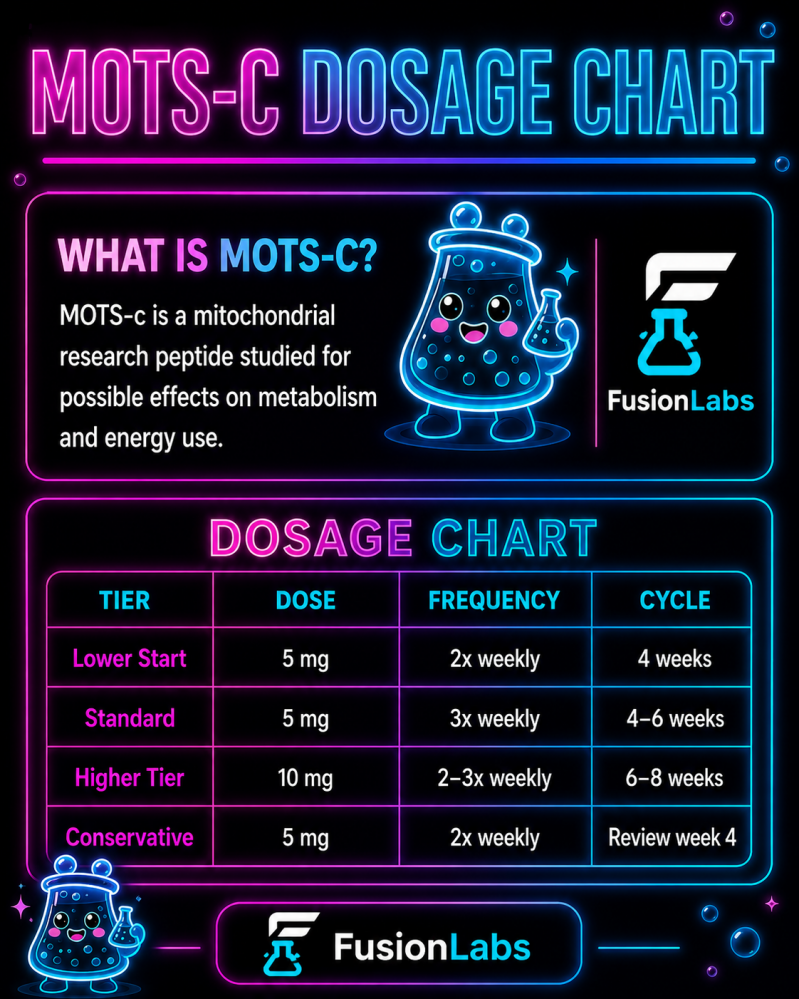
MOTS-c Dosage Chart
MOTS-c research-planning dose tiers
- Tier - Lower-end starting tier
- Dose - 5 mg
- Frequency - 2x per week
- Cycle length. - 4 weeks
Notes
Used by researchers checking tolerance and histamine response.
- Tier - Standard tier
- Dose - 5 mg
- Frequency - 3x per week
- Cycle length - 4-6 weeks
Notes
Most common research-planning anchor for steady AMPK signaling.
- Tier - Higher tier
- Dose - 10 mg
- Frequency - 2-3x per week
- Cycle length - 6-8 weeks
Notes
Reported in the upper end of community protocols. Side effects and quality risk rise with dose.
These tiers summarize community and clinic-reported research planning. None of them have been validated in a published human randomized trial. This is not a dosing recommendation. For protocol-focused research, also see Peptide Dosing Protocols.
Cycle Guidelines
- Approach - Conservative
- Duration - 4 weeks
- Off period - 4 weeks
Best for - First-time tolerance review.
- Approach - Standard
- Duration - 6 weeks
- Off period - 4-6 weeks
Best for
Most published animal protocols and community references.
- Approach - Extended
- Duration - 8 weeks
- Off period - 6-8 weeks
Best for
Used in research planning that tracks endpoints over a longer block.
Cycling is reported as a way to limit AMPK downregulation and to give a clean off-window for reviewing markers. There is no published human trial that has compared cycle lengths directly.
Where the dose ranges come from
These tiers are summarized from animal studies (Reynolds 2021, Lee 2015, Kumagai 2021), the WADA monograph, and the clinic-provider language reported in Innerbody's MOTS-c review. No FDA-approved MOTS-c label exists.
MOTS-c Supplies Needed
Plan based on a 10 mg MOTS-c vial reconstituted with 1.0 mL bacteriostatic water. At 5 mg per dose, one vial covers two doses. The math below assumes 5 mg, 2 times per week. Add one vial per week if planning 3 doses per week instead.
Plan based on a 40 mg MOTS-c vial reconstituted with 3.0 mL bacteriostatic water. At 5 mg per dose, one vial covers eight doses. The math below assumes 5 mg, 2 times per week. Last 4 weeks.
MOTS-c Vials (10 mg each)
One 10 mg vial covers two 5 mg doses. Plan one vial per week at 2x weekly.
4 weeks
4 vials
8 doses needed; one vial per week.
6 weeks
6 vials
12 doses needed; one vial per week.
8 weeks
8 vials
16 doses needed; one vial per week.
Insulin Syringes (U-100)
Use 1 mL / 100-unit U-100 insulin syringes since a 5 mg dose draws 0.5 mL (50 units).
4 weeks
8 syringes
1 syringe per injection.
6 weeks
12 syringes
1 syringe per injection.
8 weeks
16 syringes
1 syringe per injection.
Bacteriostatic Water
Use 1.0 mL per 10 mg vial for a 10 mg/mL concentration.
4-8 weeks
1 x 10 mL bottle
4 weeks: 4 vials use 4 mL total; one bottle gives margin.; 6 weeks: 6 vials use 6 mL total; one bottle gives margin.; 8 weeks: 8 vials use 8 mL total; one bottle is enough.
A 40 mg vial contains the same total amount as four 10 mg vials.
4 weeks' worth in your example (4 × 10 mg = 40 mg total) would equal 1 × 40 mg vial.
6 weeks' worth (6 × 10 mg = 60 mg total) would equal 1.5 × 40 mg vials.
8 weeks' worth (8 × 10 mg = 80 mg total) would equal 2 × 40 mg vials.
Who MOTS-c Is For and Who Should Avoid It
MOTS-c is studied in metabolic health, exercise performance, and aging research. None of those uses have been approved by the FDA. The list below is research-planning context, not a treatment recommendation.
Often researched in
Glucose handling and insulin-sensitivity research, anchored to the Lee 2015 Cell Metabolism paper.
Exercise capacity and aging research, anchored to the Reynolds 2021 Nature Communications paper.
Bone metabolism research, summarized in the Yi 2023 Frontiers in Physiology review.
Inflammation research, anchored to the Zhe 2024 Neurological Research paper on inflammatory pain models.
Should avoid or hold off
Anyone with an active cancer diagnosis, since MOTS-c effects on tumor biology are mixed in the literature and clinician sources cited by Innerbody recommend caution.
Pregnant or breastfeeding individuals, because there is no human safety data.
People taking other AMPK-activating drugs such as metformin, thiazolidinediones, or aspirin without prescriber input, because of theoretical overlap.
Athletes subject to drug testing under WADA rules, since MOTS-c is prohibited at all times under section S4.4.1.
Anyone who would not have access to a clinician if a side effect appeared.
MOTS-c Side Effects & Safety
There is no large human safety database for MOTS-c. The closest published human safety data is for CB4211, a synthetic MOTS-c analog that completed a Phase 1 trial and was reported as well tolerated. That is similar but not the same molecule, so the read-across is limited.
The U.S. Anti-Doping Agency monograph and clinician sources cited by Innerbody describe a small, mostly mild side-effect pattern in people who buy MOTS-c online.
Reported MOTS-c side effects
- Side effect - Injection site redness or swelling
- Frequency reported - Common
- What to do - Rotate sites, inject slowly.
- Side effect - Flushing or skin warmth (histamine response)
- Frequency reported - Occasional
- What to do.- Community reports describe injecting more slowly and using a lower dose in early sessions.
- Side effect - Headache
- Frequency reported - Occasional
- What to do - Persistent headache is commonly addressed by reducing the dose in community protocols; ongoing symptoms should be discussed with a clinician.
- Side effect - Mild fatigue after dose
- Frequency reported - Occasional
- What to do - Fatigue is sometimes addressed by lower doses or morning timing in reported use.
- Side effect - Heart palpitations
- Frequency reported - Reported by USADA
- What to do - Stop and seek qualified medical input.
- Side effect - Insomnia or fever
- Frequency reported - Reported by USADA
- What to do - Stop and seek qualified medical input.
MOTS-c Timeline & What to Monitor
MOTS-c does not produce a noticeable acute effect like a stimulant. The shifts described in clinic and community sources are slow and small. Inner body's clinician sources describe steadier energy in the first 1-2 weeks and possible exercise-tolerance changes by weeks 4-6.
Common reporting windows
Track what you can measure rather than what you can feel. Energy and recovery are subjective and easy to misread without a control.
MOTS-c is not a diagnostic tool. Markers like fasting glucose, A1C, and body composition can move for many reasons. Use them to look for trend, not to make medical decisions.
MOTS-c Clinical Evidence Context
Direct human evidence for MOTS-c is limited to a few cross-sectional and small-sample studies. The strongest mechanistic evidence comes from animal and cell research. The closest randomized human safety data is for the synthetic analog CB4211, not for native MOTS-c.
Human evidence (limited)
Domin and colleagues (2023, International Journal of Molecular Sciences) reported that higher serum MOTS-c levels correlated with greater lower-body muscle strength in healthy adults. This is a correlation in one small sample, not a randomized intervention trial.
Phase 1 analog data
CB4211, a synthetic MOTS-c analog, completed a Phase 1a/1b trial reported as safe and well tolerated. The molecule is related but not identical, so this safety signal does not transfer fully to native MOTS-c.
Preclinical evidence (strongest)
Lee and colleagues (2015, Cell Metabolism) showed MOTS-c reduced obesity and insulin resistance in mice on a high-fat diet. Reynolds and colleagues (2021, Nature Communications) showed running capacity improvement across mouse age groups. Kumagai and colleagues (2021, American Journal of Physiology - Endocrinology and Metabolism) reported reduced myostatin and atrophy signaling in mice. Yi and colleagues (2023, Frontiers in Physiology) reviewed bone-metabolism findings.
Mechanism review
Wan and colleagues (2023, Journal of Translational Medicine) and Kong and colleagues (2023, Diabetes & Metabolism Journal) reviewed AMPK activation, mitochondria-to-nucleus signaling, and the link between MOTS-c and aging-related metabolic disease.
Evidence gap
No published human randomized controlled trial has tested native MOTS-c for any clinical endpoint. Treat the dose tiers on this page as research-planning context, not as proof of human benefit.
MOTS-c Protocol Mistakes & Troubleshooting
01
Missed dose
Research protocols describe skipping to the next scheduled dose rather than doubling up after a one-day miss. This is a protocol convention, not a personal recommendation.
02
Cloudy or speckled vial
Do not inject. A cloudy or particulate vial means the peptide may be degraded or the solution may be contaminated. Discard it.
03
Wrong BAC water volume
If you used 2.0 mL instead of 1.0 mL, your concentration dropped to 5 mg/mL. A 5 mg dose then becomes 1.0 mL (100 units), not 0.5 mL (50 units). Recalculate before drawing.
04
Strong flushing or itching
MOTS-c can trigger histamine release. Persistent flushing or itching warrants stopping and seeking qualified medical input before any dose or timing changes.
05
Injection-site reaction
A small red mark for a few hours is common. Persistent swelling, hardness, or warmth lasting more than 48 hours is a stop signal.
06
Storage mistake
If a reconstituted vial sat at room temperature for more than a few hours, treat it as compromised. Do not inject older or warm-stored MOTS-c.
07
Confusion about the schedule
MOTS-c is dosed 2-3 times per week, not daily. Daily dosing is associated with a different protocol (1 mg) seen in one community source and is not the dominant pattern in published animal work.
If something feels wrong
Stop dosing and contact a qualified healthcare provider. This page does not cover medical emergencies.
MOTS-c Regulatory Status
MOTS-c is not FDA-approved for any human use as of June 2026. Research-grade vials sold in the U.S. are labeled for laboratory and research use only.
FDA 503A timeline
- Late 2023: FDA placed MOTS-c on Category 2 of its 503A bulks list, the category for substances flagged for significant safety concerns.
- February 27, 2026: HHS Secretary Robert F. Kennedy Jr. publicly stated an intent to move 14 of the 19 Category 2 peptides back to Category 1. A statement is not a rule change.
- April 15, 2026: FDA announced removal of 12 peptides from Category 2, including MOTS-c, because the original nominators withdrew their nominations.
- April 22, 2026 (effective date): Removal from Category 2 took effect. Removal from Category 2 does not make a substance Category 1, and it does not add the substance to the 503A Bulks List.
- July 23, 2026 (scheduled): Pharmacy Compounding Advisory Committee meeting to discuss MOTS-c (free base and acetate forms) for 503A Bulks List inclusion.
Practical effect: as of June 2026, MOTS-c is not legally compoundable as a Category 1 substance, has been removed from Category 2, and is awaiting PCAC review. The status can change after July 23, 2026. Verify the current FDA list before assuming legality.
WADA / sports testing
MOTS-c is named explicitly on the 2026 WADA Prohibited List under section S4.4.1 (AMPK activators) and is prohibited at all times. Any athlete subject to anti-doping testing should not use MOTS-c.
Sources & Research
- 1. Lee C, Zeng J, Drew BG, et al. The mitochondrial-derived peptide MOTS-c promotes metabolic homeostasis and reduces obesity and insulin resistance. Cell Metabolism (2015)
- 2. Reynolds JC, Lai RW, Woodhead JST, et al. MOTS-c is an exercise-induced mitochondrial-encoded regulator of age-dependent physical decline and muscle homeostasis. Nature Communications (2021)
- 3. Kumagai H, Coelho AR, Wan J, et al. MOTS-c reduces myostatin and muscle atrophy signaling. American Journal of Physiology - Endocrinology and Metabolism (2021)
- 4. Wan W, Zhang L, Lin Y, et al. Mitochondria-derived peptide MOTS-c: effects and mechanisms related to stress, metabolism and aging. Journal of Translational Medicine (2023)
- 5. Kong BS, Lee C, Cho YM. Mitochondrial-encoded peptide MOTS-c, diabetes, and aging-related diseases. Diabetes & Metabolism Journal (2023)
- 6. Domin R, Pytka M, Niziolek-Szynczak A, et al. MOTS-c serum concentration positively correlates with lower-body muscle strength and is not related to maximal oxygen uptake — a preliminary study. International Journal of Molecular Sciences (2023)
- 7. Yi X, Hu G, Yang Y, et al. Role of MOTS-c in the regulation of bone metabolism. Frontiers in Physiology (2023)
- 8. Zhe W, Liu Y, Han P, et al. Central and peripheral mechanism of MOTS-c attenuates pain hypersensitivity in a mice model of inflammatory pain. Neurological Research (2024)
- 9. Yin Y, Pan Y, He J, et al. Mitochondrial-derived peptide MOTS-c suppresses ovarian cancer progression by attenuating USP7-mediated LARS1 deubiquitination. Advanced Science (2024)
- 10. U.S. Anti-Doping Agency. What is the MOTS-c peptide? USADA (2024)
- 11. World Anti-Doping Agency. The 2026 Prohibited List - Section S4.4 Metabolic Modulators (MOTS-c named under AMPK activators). WADA (2026)
- 12. U.S. Food and Drug Administration. Bulk Drug Substances Nominated for Use in Compounding Under Section 503A — MOTS-c removal from Category 2 (effective April 22, 2026); PCAC consultation scheduled July 23, 2026. FDA (2026)
- 13. Alzheimer's Drug Discovery Foundation. MOTS-c — Cognitive Vitality Report (notes CB4211 Phase 1 safety read-across). ADDF (2021)